


Iran Prosperity Project, the Win Win Senario
“The coincidence of this event with Holocaust Remembrance Day recalls a crime in which millions of Jews were brutally murdered. It also compels us to remember the Iranian victims of what we call an “Iranian Holocaust”—victims of terror, massacre, and execution not only in the past three months, but over the past 47 years.
So I would like to propose a moment of silence for both the Jewish victims of the Holocaust and the Iranian victims of this ongoing tragedy. A moment of silence for Nika, for Sepehre baba, and for thousands of other innocent people—from Abbas Hoveyda to Fereydoun Farrokhzad.
…
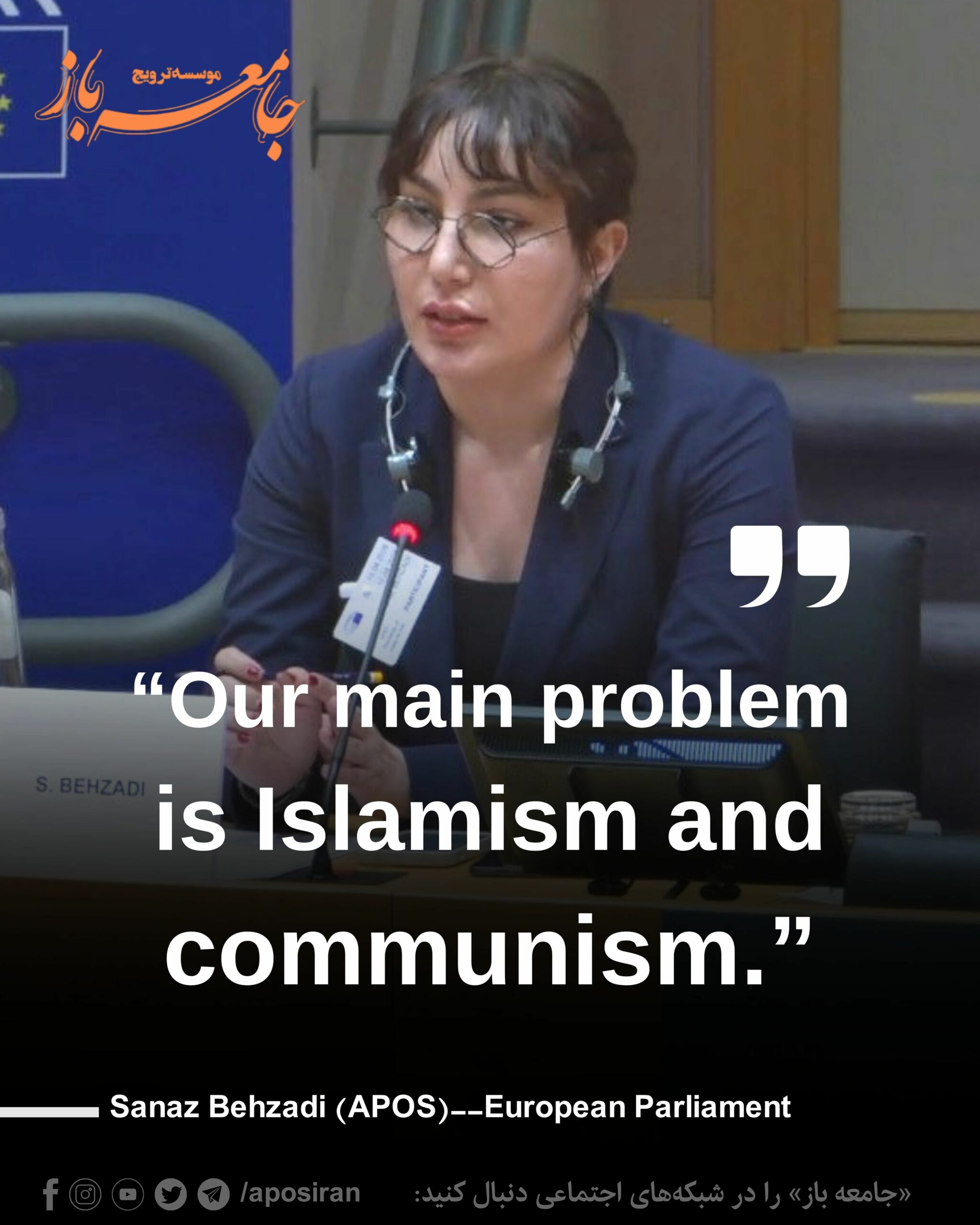
Dear everyone, I appreciate the opportunity to address one of the key challenges of European foreign policy. My name is Sanaz Behzadi. I represent the Association for the Promotion of Open Society—an institution active in the fields of democratic transition, civil society development, good governance, and policy dialogue on Iran.
Let me be clear from the outset: This discussion is not only about Iran; it is directly linked to Europe’s strategic interests, its energy security, and its role in shaping one of the most sensitive geopolitical transitions of our time. What is unfolding in Iran today is not a temporary crisis, but the convergence of three deep and accelerating trends:
First, the widespread collapse of the political legitimacy of the Islamic Republic—a reality clearly reflected in the continuation of protests, reports by independent institutions, and the regime’s increasingly defensive reactions.
This repression has not been merely political; over the past 47 years, patterns of inequality and discrimination in Iran have been driven less by purely ethnic targeting and more by structural factors—namely unaccountable governance, rent-seeking resource allocation, uneven regional development, and systematic political exclusion—structures that, without institutional reform, will continue to reproduce themselves.
Second, the escalation of military tensions in the region, with a real risk of expanding into a transregional conflict. And third—an issue that’s received not enough attention in policy discourse—the question of transition in Iran is no longer a distant prospect; it is a present reality. The question is no longer whether change will occur, but what form it will take and whether we are prepared for it.
These trends taken together have turned Iran into a critical node in the global security and economy—with direct implications for Europe. Ladies and gentlemen, Allow me to highlight a geopolitical reality: The Strait of Hormuz is not merely a regional waterway; it is the most vital chokepoint in the global energy infrastructure. Around 20 percent of the world’s oil trade passes through it daily, a significant portion of which reaches Europe.
The Islamic Republic has repeatedly threatened to block this route—and under escalating crisis conditions, this threat is no longer hypothetical. Its consequences for Europe are clear: energy price spikes, inflationary pressure, and the risk of economic instability. The war in Ukraine has already demonstrated how energy dependence can become a strategic vulnerability—one that, with Iran, can be repeated on a larger scale.
Yet this reality also has another dimension: a stable and democratic Iran would not use this position as leverage, but could instead become a reliable partner for Europe’s energy security and regional stability. This is not idealism, but a clear definition of strategic interest.
Ladies and gentlemen, We are not here merely to describe a crisis, but to present a practical path forward. A real win-win scenario exists—rooted in a structured transition framework designed by a team of capable Iranians. The “Iran Prosperity Project,” led by Prince Reza Pahlavi, is not an abstract proposal, but a phased roadmap for political transition focused on fundamental reforms, preventing a power vacuum, and establishing democratic governance. In any transition process, having a unifying political center is crucial. Today, initiatives around the leadership of Prince Reza Pahlavi have been able to create part of this capacity.
Alongside this, transitional justice is decisive. The Islamic regime in Iran faces a heavy record of human rights violations, and without accountability mechanisms, any transition risks descending into cycles of revenge. For this reason, efforts are underway—by a committee under the leadership of Shirin Ebadi within the project team—to design mechanisms for truth-seeking, accountability, and social reconciliation, with the aim of balancing justice and stability. History shows that without this balance, sustainable transition is not achievable. Ladies and gentlemen,
Within this framework, a contradiction must also be addressed: The continued operation of Islamic Republic embassies in Europe—while the same unaccountable structures are the source of the crisis—is not aligned with democratic objectives. A reassessment of this approach could form part of a more coherent, values-based policy. We Iranians living in Europe consider it our home and see our children’s future here. For this reason, we speak to you today both as Iranians and as European citizens. The European Union’s approach has so far been largely cautious and reactive. But given the pace of developments, this approach is at risk of missing a decisive moment. Therefore, three concrete steps are recommended:
First, revising Europe’s diplomatic tools—shifting from crisis management toward preparedness for transition scenarios; Second, establishing structured dialogue with civil society and responsible opposition actors, particularly those committed to non-violent, institutional approaches; And third, taking a more active role in shaping the international conversation on Iran’s future—before events reduce Europe to a purely reactive position.
Ladies and gentlemen,
Iran is entering one of the most consequential turning points in its modern history.
How this transition is managed will affect not only millions of Iranians, but also regional stability, Europe’s energy security, and the credibility of the international community. What is required now is an accurate understanding of realities, readiness for multiple scenarios, and the political will to act decisively and responsibly.
This window is still open.
The Association for the Promotion of Open Society stands ready to contribute—through analysis, facilitation of dialogue, and engagement
with Iranian civil society.
A win-win outcome is possible—
but only with timely action.”
Sanaz Behzadi — senior analyst and journalist at APOS– April 15, European Parliament.