


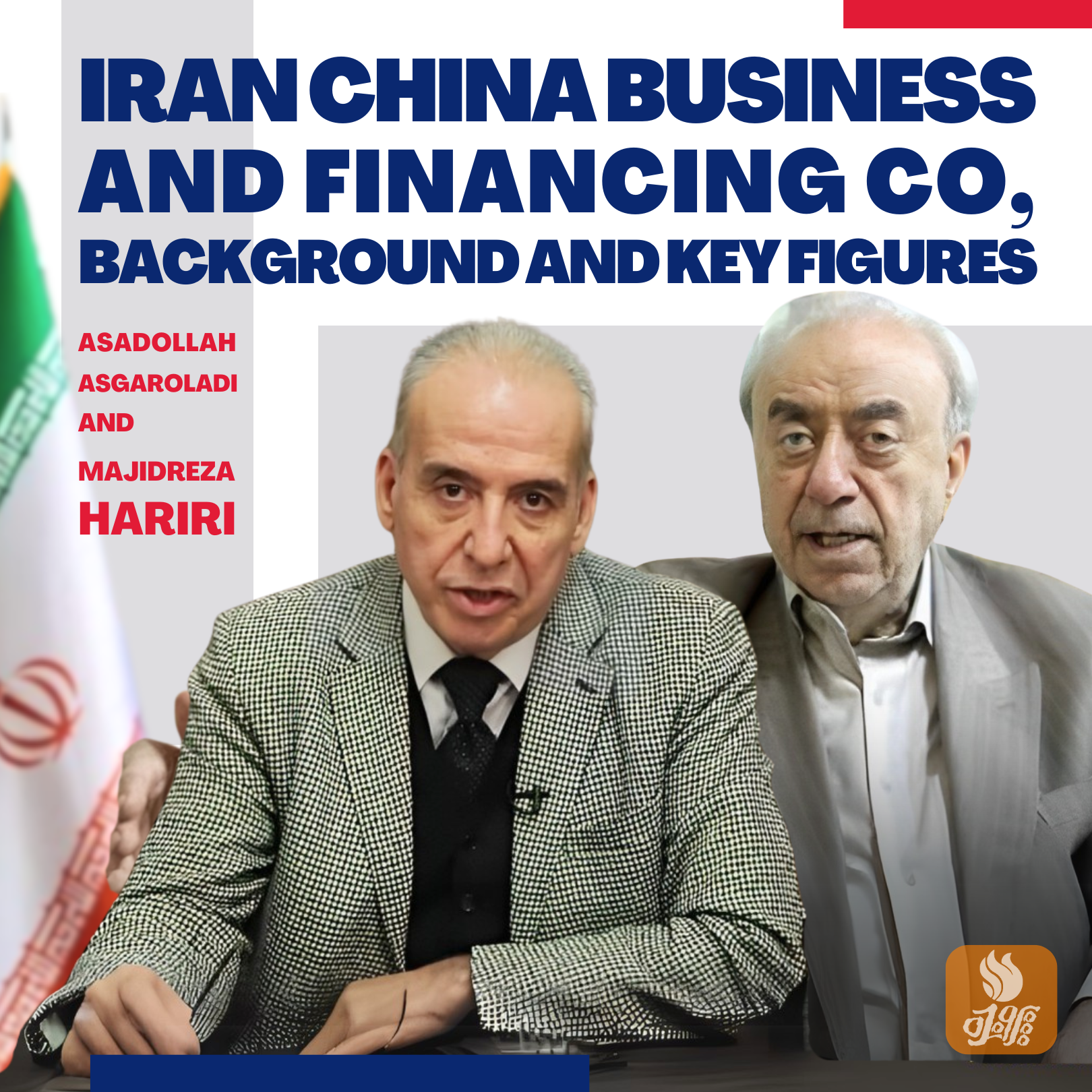
Iran China Business and Financing Co. Background and Key Figures
Iran China Business and Financing Co serves as a key facilitator and influencer in trade and business relations, fostering bilateral cooperation between private and semi-governmental companies in Iran and China. Founded in 2001 by a consortium of 65 prominent Iranian entrepreneurs, the organization later evolved into the “Iran-China Business Chamber” and the “Iran-China Joint Chamber of Commerce and Industries” (ICCCI). This solidified its role in advancing bilateral cooperation. This cooperation between Iranian state-owned companies and Chinese partners lacks transparency and the private sector plays no role in it. This situation has practically paved the way for corruption and rent-seeking.
In recent years, Iran has regarded China as its partner against the United States and European countries. Following the U.S. withdrawal from the JCPOA, in which China was also a participant, Iran has sought to bypass U.S. sanctions through its partnership with China. Official data and reports highlight long-term plans between Tehran and Beijing to enhance trade relations further. For instance, Iran’s trade volume with China has so far reached USD 20 billion while Iran’s trade volume with China in the years before the JCPOA, for example, in 2016 was about $10 billion. Notably, both nations have set an ambitious target to raise this figure to USD 160 billion. The Iran-China Business Chamber plays a pivotal role in facilitating and advancing these efforts.
Influence and Power: The Role of the Asgaroladi Family
The Asgaroladi family has long been a cornerstone of Iran’s post-revolutionary political and economic landscape, known for their deep ties to the Islamic Republic’s leadership and their influence in commerce and politics.
One of the key founders of the chamber was Asadollah Asgaroladi, a highly influential and trusted businessman closely connected to the Supreme Leader of the Islamic Republic. Asadollah’s brother, Habibullah Asgaroladi, served as the Minister of Commerce in several post-revolutionary governments. He was also one of the three individuals appointed by Ayatollah Ruhollah Khomeini to the board of trustees of “Setad-e Emam” (or EIKO), highlighting his significant role within Iran’s government. This suggests that the Asgaroladi family held important political and economic positions in the Islamic Republic for many years, likely benefiting from substantial economic advantages. In an interview with the Khabar Online website in February 2012, Asadollah Asgaroladi explained how, as a result of his contacts with Islamic Republic officials and Ruhollah Khomeini’s office, he was able to obtain important economic information, and through this, for example, he bought five houses in Tehran and owned 10 factories. The family was also affiliated with the Islamic Motalefeh Party, a conservative and religious political group that has historically supported the traditional ruling clerics.
The Chinese equivalent of the ICCCI
The Iran-China Joint Chamber of Commerce, collaborates with the China Council for the Promotion of International Trade (CCPIT) or the China Chamber of International Commerce (CCOIC). Established in 1952, CCPIT is officially described as a “nongovernmental organization” focused on promoting trade while operating under government guidance. However, the U.S. government has classified it as an organization which is controlled by the CCP since at least 1957.
CCPIT operates a national headquarters, regional branches across China, and international offices, although it does not currently have a presence in Iran. In April 2022, CCPIT signed a Memorandum of Understanding (MOU) with the Iranian Chamber of Commerce, Industry, and Mines.
Activities and Scope of Work
According to available data, ICCCI currently offers its members and associates services in the following areas:
- Compiling an economic database detailing the laws and regulations of both countries;
- Organizing trade events and exhibitions to foster economic opportunities for both nations;
- Establishing communication channels with key decision-makers in both countries;
- Identifying challenges and resolving conflicts in bilateral economic relations;
- Facilitating joint investment ventures between the two nations;
- Developing solutions to promote the sustainable growth of business relationships;
- Enhancing members’ knowledge and skills through training programs;
- Strengthening mutual understanding between communities and societies of both parties;
- Continuously improving the organization’s activities both in quality and quantity.
The chamber was initially founded with 65 members, but it has grown significantly over the years and now boasts approximately 7,000 members. All of these circumstances strengthen the possibility that membership in this institution could actually be an opportunity for companies and their members to benefit from greater rents. Given the extensive network of corruption and the large number of quasi-state companies in the Islamic Republic, the rapid increase in the number of members of this institution is not surprising.
To read the whole dossier of ICCCI, download this file: