
Tiandy: Use of Surveillance for Identification and Suppression
- Categories
- Dossier
Tiandy: Use of Surveillance for Identification and Suppression
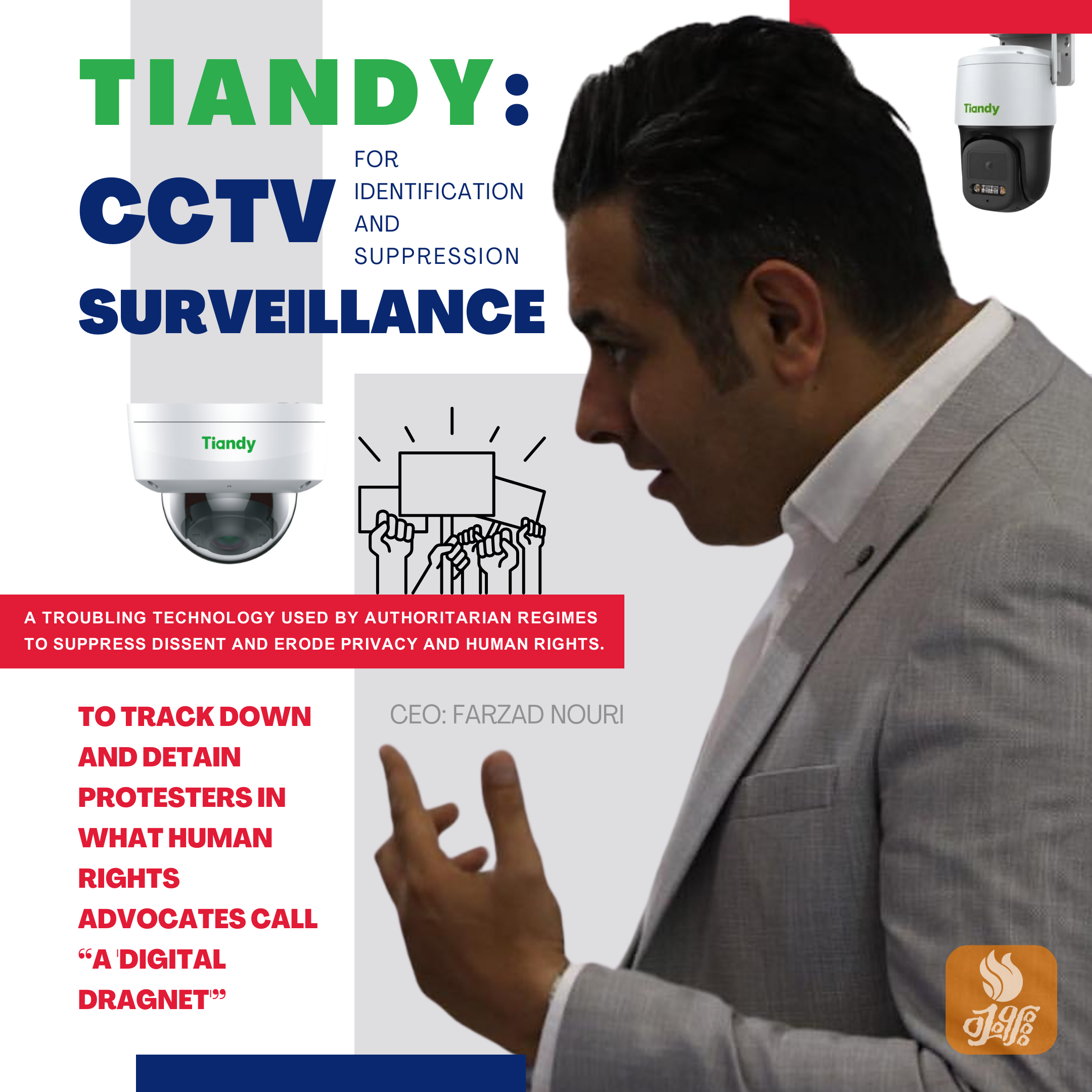
Behind Iran's intensifying crackdown on dissent lies a web of Chinese surveillance cameras, supplied by tech giant Tiandy, enabling authorities to track and detain protesters in what human rights advocates call a 'digital dragnet.'
Particularly in 2022-2023 Iran experienced widespread protests called “Woman, Life, Freedom” sparked by the killing of Mahsa Amini by the Morality Police. As these protests grew and the potential for their resurgence remained, the Islamic Republic intensified efforts to identify and suppress dissent, notably through the extensive use of surveillance cameras across urban areas. Over the past year, numerous reports have highlighted the installation of such cameras in Tehran and other cities nationwide.
Surveillance technologies have played a key role in enabling the regime to monitor and punish citizens based on recorded evidence. Tiandy, a Chinese company, has supplied products extensively used by Iran's government to locate and detain protesters.
Tiandy Company
Tiandy, a Chinese company specializing in surveillance technology, began its operations in Iran in 2006, as noted in official Iranian newspaper advertisements. Notably, many of Tiandy's products incorporate Intel chips, which are restricted for sale in Iran due to U.S. sanctions. Tiandy collaborates closely with security and law enforcement agencies of the Islamic Republic. For example, an archived version of its website explicitly listed the Islamic Revolutionary Guard Corps (IRGC) as a client. Additionally, Tiandy participated in the International Police, Security, and Safety Equipment Exhibition (IPAS) held in Tehran in 2018.
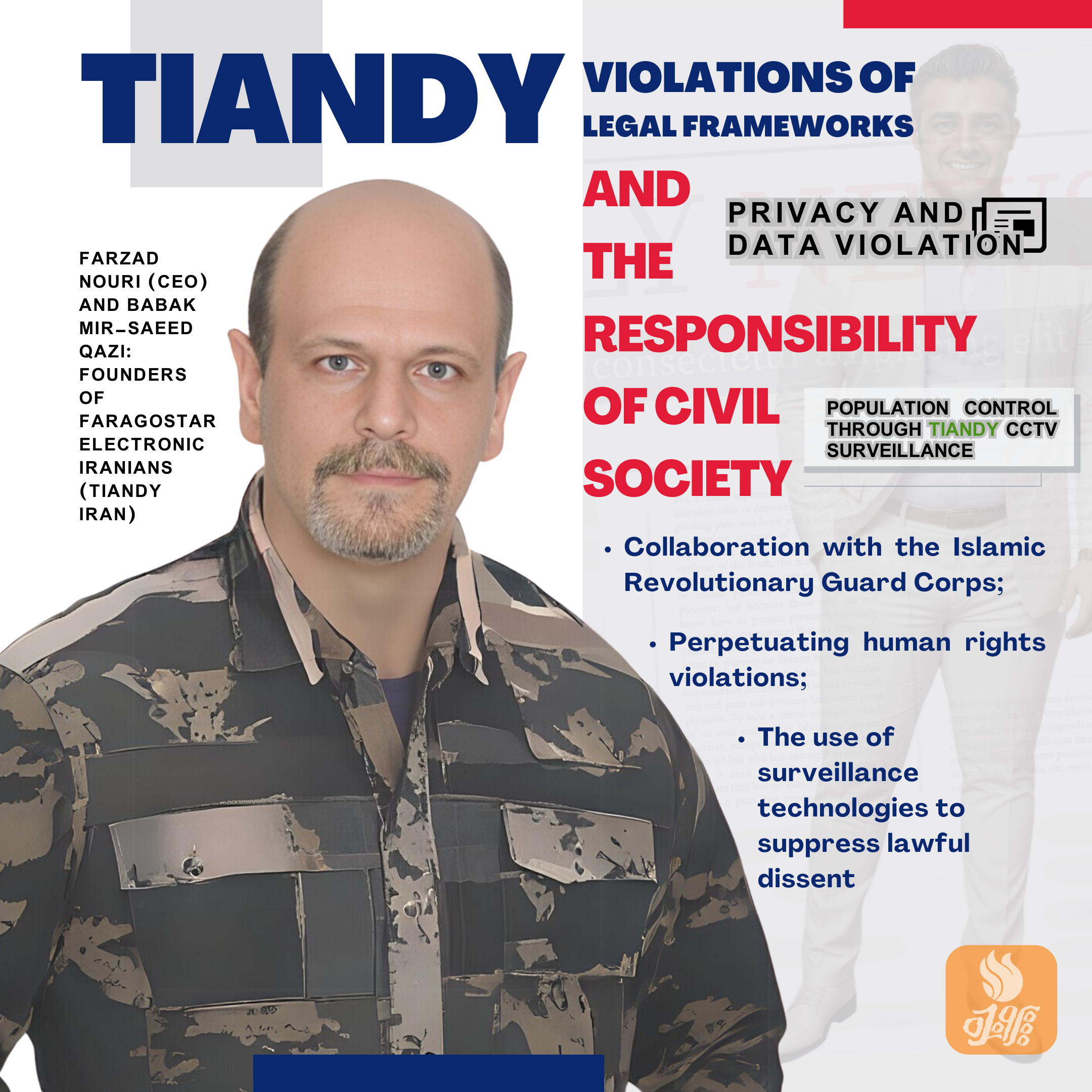
Although Tiandy's name and branding are not directly mentioned in Iranian newspaper advertisements, public records indicate that Faragostar Electronic Iranians, operating under the name Tiandy Iran, has represented the company since 2006. The company's marketing materials prominently feature Tiandy's logo. According to foundational advertisements, Faragostar was established by Farzad Nouri (CEO) and Babak Mir-Saeed Qazi. Online records link Babak Mir-Saeed Qazi to various IRGC divisions, government agencies, financial institutions, and organizations like the Astan Qods-e Razavi, which operates under the Supreme Leader's authority.
Cooperation with authoritarian political systems
Beyond its operations in Iran, Tiandy's broader business practices and partnerships reveal a concerning pattern.
Tiandy’s strategic positioning in the surveillance industry highlights its ambition to expand its global influence, particularly by serving the demands of authoritarian regimes intent on suppressing opposition and dissent. This growth extends beyond merely providing advanced surveillance technology; it involves establishing strong partnerships with influential state and security entities in nations like Iran and China, where surveillance becomes a central instrument of governance.
In 2021, Tiandy's estimated revenue exceeded 800 million dollars. Recent estimates suggest that more than 540 million surveillance cameras have been installed across China.
Tiandy’s activities highlight a troubling trend of advanced surveillance technology being used by authoritarian regimes to suppress dissent and erode privacy and human rights. The company’s role underscores the complex relationship between tech providers, state security forces, and the diminishing of fundamental freedoms.
In recent years, under the regime's "Look to the East" foreign policy strategy, cooperation between the Islamic Republic of Iran and China and Russia has grown significantly. This partnership extends across multiple domains, including trade, economic development, security, and international relations. the widespread use of Tiandy cameras aligns with Tehran's efforts to strengthen its cooperation with Beijing.
Providing services and technology to suppress protesters
The practical implementation of Tiandy's surveillance technology in Iran demonstrates how these political partnerships translate into tools of repression.
Reports indicate that Tiandy cameras are equipped with advanced features that are widely utilized by security agencies in countries like the Islamic Republic of Iran and China. Tiandy Iran claims that its cameras offer capabilities such as "intrusion detection," "crowd congestion detection alarm," "running detection alarm," "line crossing detection," "region entrance detection," and even "people counting."
These features allow security forces, police, and military to capture clear images of protesters even in low light, aiding in subsequent actions such as arrests, torture, and legal prosecution. The "crowd detection alarm" capability helps isolate individuals within a crowd, making it easier to identify and target specific protesters or groups gathered in certain areas.
The importance of such technologies for Iran
Understanding the strategic significance of these surveillance systems helps explain why the Iranian government continues to invest in them despite their technical limitations.
The increasing frequency of anti-government protests in Iran has heightened the need for the Islamic Republic's security forces to rely on technologies like surveillance cameras. These tools help them quickly identify and arrest protesters, as well as target women who oppose the mandatory hijab.
Some argue that many of the cameras are ineffective, lack power, or fail to function altogether. However, their installation in crowded urban areas primarily serves as a tool of intimidation, creating a constant sense of surveillance among the public. Despite this, the ongoing protests against the compulsory hijab in Iran and the presence of numerous women in Tehran and other cities defying the mandate demonstrate that advanced technologies cannot suppress the freedom-driven aspirations of the Iranian people.
Related posts
Tiandy, Violations of Legal Frameworks
Tiandy, Violations of Legal Frameworks and the Responsibility of Civil Society Tiandy's collaboration with Islamic Revolutionary Guard Corps (IRGC), a key entity in Iran's…
Continue reading
International Community's Awareness of Tiandy's Role
International Community's Awareness of Tiandy's Role There is significant evidence that the Islamic Republic, particularly its security agencies, has intensified cooperation with…
Continue reading
Suspicious Connections and Kleptocratic Activities
Suspicious Connections and Kleptocratic Activities One of the key founders of the Iran-China Chamber of Commerce was Asadollah Asgaroladi, a prominent and influential businessman…
Continue reading