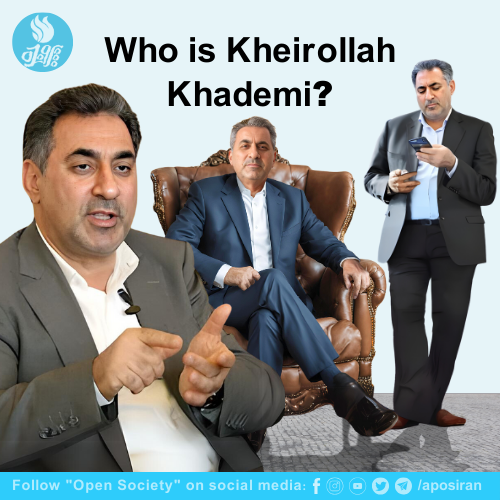
Who is Kheirollah Khademi?
(the fourth dossier)
Kheirollah Khademi was born in 1965 in Andimeshk County and holds a PhD in Civil Engineering from Chamran University of Ahvaz, obtained in 2012.
State media in Iran refer to Khademi as a “warror in the Iran-Iraq War” and also as an “official member of the Islamic Revolutionary Guard Corps.”
In the Islamic Republic, Kheirollah Khademi has an extensive executive background. He served as the mayor of Andimeshk for three years starting in 2001. He then moved to provincial responsibilities, becoming the Director-General of Roads and Transportation in Khuzestan Province for five years starting in 2004. Khademi was subsequently promoted to Deputy for Civil Affairs in Khuzestan Province from 2008 for nearly two years.
From 2012, Khademi’s executive responsibilities extended beyond Khuzestan Province, reaching national level positions during Mahmoud Ahmadinejad’s government. Appointed by the then Minister of Roads and Urban Development, he became the Chief Executive Officer of “Iran Construction and Development of Transportation Infrastructure Company (CDTIC)” and moved to Tehran. His role in this company led to his position as Deputy Minister of Roads and Urban Development.
Review of Kheirollah Khademi’s Activities
An examination of Kheirollah Khademi’s activities reveals several controversial points regarding his corruption-related actions:
1. Corruption in Bitumen Distribution: Systematic corruption in the national transportation system;
2. Close Ties with IRGC Commanders: Khademi’s potential candidatory for the position of CEO of Khuzestan’s Water and Electricity Organization suggested by Parviz Fattah, a well-known IRGC member and manager who is under U.S. sanctions;
3. International Relations Contradicting National Interests: The 25-year cooperation agreement between Iran and China in March 2021.
Additionally, an analysis of this Islamic Republic politician’s actions reveals:
– In Iran, actions that involve misuse of public office for personal gain, manipulation of state resources, or collusion with private entities for illicit gain are typically considered corrupt.
– Legal violations would include forgery, embezzlement of public funds, and abuse of power. For example, according to the proposal No. 88/16/K dated 05/6/2003, the presidential body based on Article 138 of the Constitution of the Islamic Republic of Iran approved the implementation of the “Program for Improving the Administrative System and Combating Corruption”.
– Culturally, such behavior is a significant departure from the expectations of integrity and transparency expected of public officials, especially those in influential positions such as Khademi’s.
Khademi’s activities raise suspicions about corruption patterns and suggest that the benefits of his actions extend to other political and military figures within the Islamic Republic. His close relationships with the IRGC and influential political figures indicate potential illegal use of connections for personal gain. The lack of transparency and accountability in his dealings, particularly in large-scale projects, is inconsistent with legal standards and cultural norms for governance in the Islamic Republic. The review of Khademi’s activities reveals numerous instances of potential corruption-related actions.
Further details on these findings can be found here:
#OpenSociety