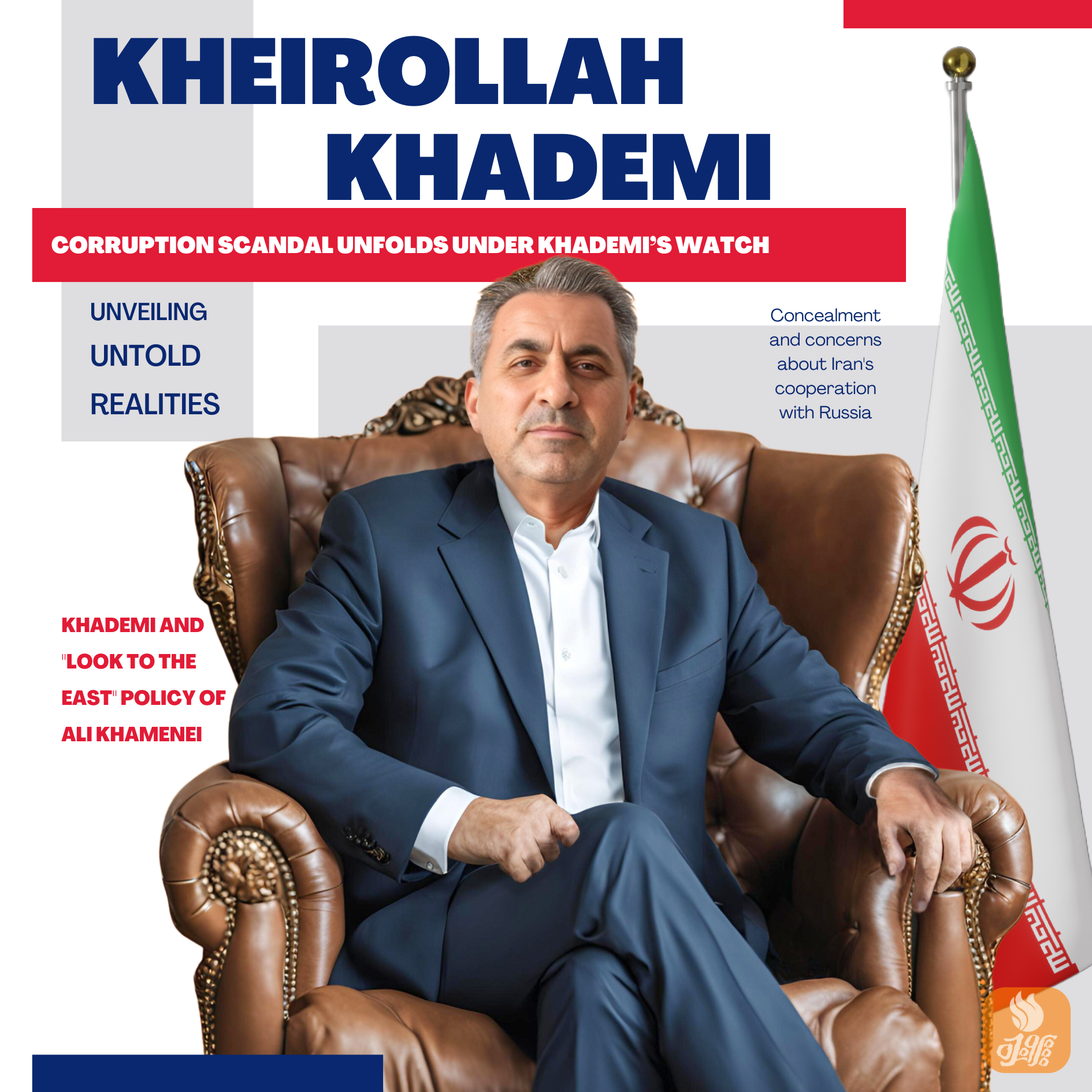
Corruption Scandal Unfolds Under Khademi’s Watch
(the fourth dossier)
Kheirollah Khademi’s professional career, particularly his tenure as Iran’s Deputy Minister of Roads and Urban Development, has been overshadowed by multiple corruption scandals. Notably, Kamal Alipour, a member of the Iranian parliament, exposed widespread corruption and rent-seeking in the distribution of free bitumen for asphalt during Khademi’s time in office.
Citing reports from Iranian security agencies, Alipour revealed that certain government officials had colluded with bitumen producers to fraudulently obtain free bitumen through falsified documents. He pointed out that this misconduct resulted in several problems, including incomplete infrastructure projects, unnecessary financial strain on the government, and widespread misallocation of public resources.
Rostam Qasemi, the then-Minister of Roads and Urban Development, sounded alarms about systemic corruption and rent-seeking practices related to the controversial asphalt case. Despite these warnings, the scandal did not result in serious consequences for those involved. Reports from various media outlets suggested that several high-ranking officials in the Islamic Republic might have been implicated, and the decision not to pursue the case was likely made to protect their identities from public scrutiny.
Khademi’s Contributions to Iran’s Ties with China and Russia
Under Ali Khamenei’s guidance, the Islamic Republic has adopted a “Look to the East” policy to bolster its relationships with key regional powers. In this context, Khademi has played a pivotal role in advancing Iran’s connections with countries like China and Russia, particularly focusing on transportation and railway projects.
A review of Khademi’s career reveals a consistent pattern of pursuing agreements with Russian and Chinese companies. This strategy appears aimed at reaffirming his loyalty to Iran’s Supreme Leader and aligning with his anti-Western policies.
In February 2018, Khademi announced that the completion of the Tehran-North Freeway hinged on clinching a deal between Iran and Chinese firms. By March 2018, he had signed a $700 million contract with Sinconst, a Chinese company, for the construction of a 450-kilometer railway stretching from Shiraz to Bushehr.
In line with Khamenei’s “Look to the East” policy, Khademi has made multiple trips to Russia to bolster relations between Tehran and Moscow and has also hosted Russian delegations in Iran. A notable instance occurred in October 2023, when Khademi welcomed Yuri Kozmin, the CEO of Caspian Services, and his delegation during their visit to Iran.
Nonetheless, not all aspects of Khademi’s negotiations and interactions with Russian counterparts are publicly disclosed. Like many other Iranian officials in similar cases, he stated in January 2023 that details of the discussions with Russia about their involvement in Iran’s railroad projects are deemed “confidential.” The secrecy and lack of transparency have sparked concerns among Iranian activists about the terms of the agreements between Tehran and its eastern allies.
This important fact should not be overlooked that Khademi’s role in strengthening Iran’s relations with China and Russia, especially in transportation and infrastructure development, underscores his importance in Iran’s foreign policy.
Khademi’s Possible Role in Undermining Iran’s National Interests
Khademi has cultivated extensive connections with officials from countries partnering with Iran, notably India. In November 2017, Iranian media highlighted Khademi’s meeting with India’s ambassador to Iran, Saurabh Kumar, at the Transport Infrastructure Development Company. The discussion centered on potential cooperative ventures between New Delhi and the company.
Despite these efforts, the economic and political relationship between Iran and India has seen significant fluctuations. A case in point is the July 2020 announcement by Khademi that India had withdrawn from the Zahedan-Chabahar railway project, citing a three-year delay caused by issues on India’s side.
Many analysts argue that Khademi’s approach to cooperation with India may not align with Iran’s national interests.
Khademi: The De Facto Minister Shaping Strategic Decisions
Khademi often makes decisions and delivers speeches as the “authorized representative of the Minister of Roads and Urban Development” during provincial visits. This effectively positions him as the de facto Minister of Roads and Urban Development in the Islamic Republic, who maintains steady influence despite shifts in power between reformist and conservative factions. In the hierarchical structure of the Iranian theocracy, his enduring role can be largely attributed to his strong connections with the Islamic Revolutionary Guard Corps and key figures appointed by Ali Khamenei.
To read the “The Importance of Kheirollah Khademi in the Structure of the Islamic Republic” article click here.
Further details on these findings can be found here:
#OpenSociety